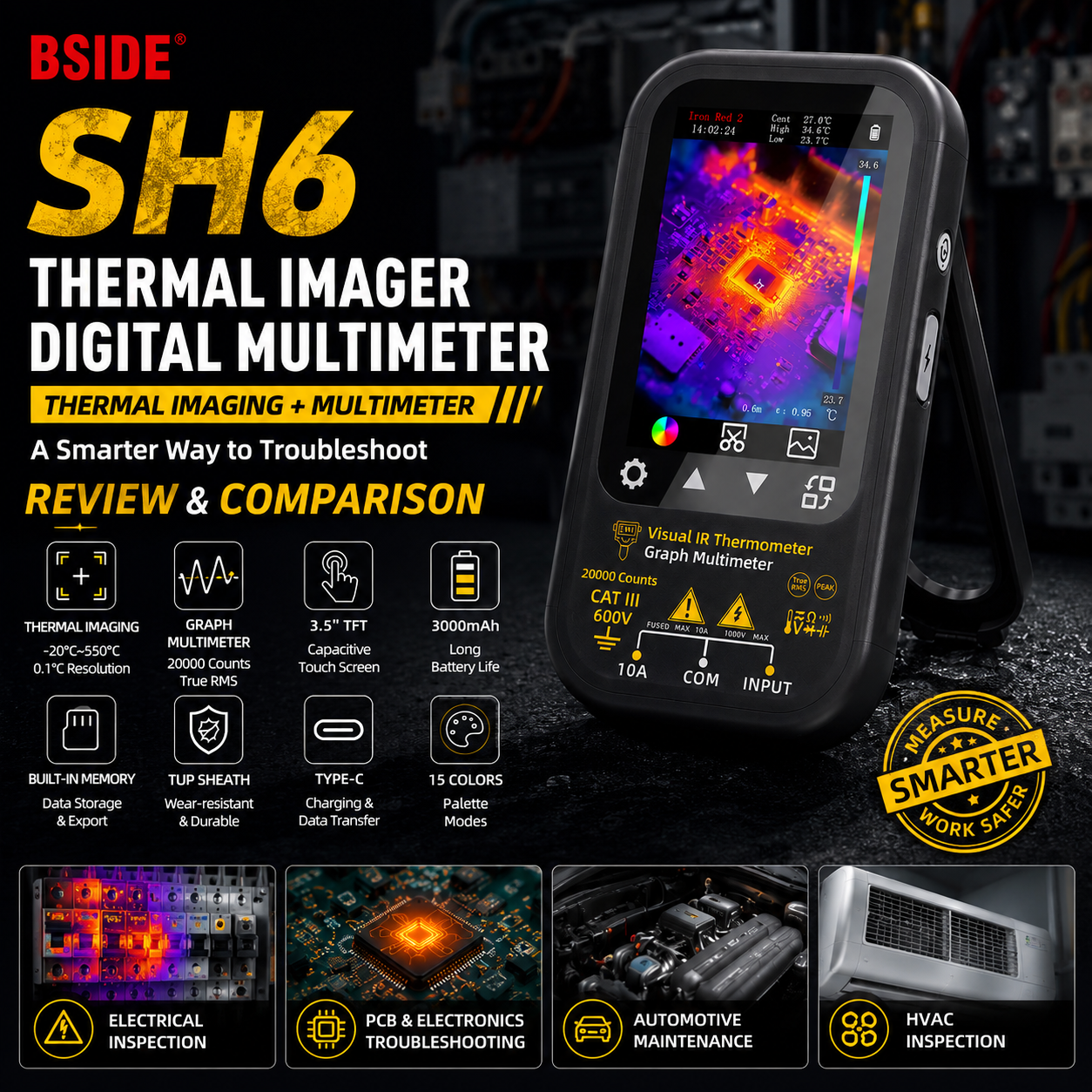
BSIDE SH6 Thermal Imager Digital Multimeter Review: A Practical Tool for Real-World Troubleshooting
For anyone who works with electrical systems, electronics, HVAC equipment, or maintenance tasks, troubleshooting is rarely just about getting a number on a display. A voltage reading can tell you one part of the story, but it may not show you where heat is building up, where a component is under stress, or which connection is starting to fail.
That is where a thermal imager digital multimeter becomes useful.
The BSIDE SH6 Thermal Imager Digital Multimeter is designed for users who want both thermal inspection and electrical measurement in one handheld tool. Instead of carrying a separate infrared camera and a separate multimeter for every job, the SH6 brings the two functions together in a more compact format.
It is not trying to replace every high-end industrial thermal camera on the market. Instead, it sits in a practical middle ground: more visual and informative than a standard multimeter, but more accessible and portable than many premium thermal multimeter systems.
What Is the BSIDE SH6?
The BSIDE SH6 is a thermal imaging digital multimeter that combines a visual IR thermometer, graph multimeter functions, and a touchscreen interface. Based on BSIDE’s product listing, the SH6 is sold as a thermal imager digital multimeter on BSIDEMeter.com, with pricing shown from around $299.89 at the time of checking.
From the product materials, the SH6 focuses on several practical features:
- Thermal imaging plus multimeter testing
- 3.5-inch TFT capacitive touchscreen
- 20,000-count graph multimeter
- CAT III 600V safety rating
- Temperature range from -20°C to 550°C
- 0.1°C temperature resolution
- Adjustable emissivity from 0.01 to 1.00
- 15 color palette modes
- Built-in memory card for image storage and export
- Type-C charging and data transfer
- TUP protective sheath and drop-resistant design
- Extendable bracket for hands-free viewing
These features make the SH6 especially useful when a technician needs to see a thermal problem first, then test it electrically.
Why Thermal Imaging Matters in Electrical Testing
A standard digital multimeter is excellent for confirming voltage, resistance, continuity, current, capacitance, and other electrical values. But it does not show heat distribution.
Thermal imaging helps reveal issues such as:
- Overheating terminals
- Loose electrical connections
- Unbalanced load conditions
- Hot PCB components
- HVAC airflow or compressor issues
- Automotive electrical faults
- Heat buildup around relays, fuses, or wiring
For example, if a breaker panel has one terminal running hotter than the others, a normal meter may only confirm voltage after you already know where to test. A thermal imager lets you scan the panel first and quickly identify the suspicious area.
That workflow can save time:
Scan → Identify hotspot → Test with multimeter → Confirm the fault → Repair or monitor
This is the real value of a tool like the BSIDE SH6.
Practical Applications of the BSIDE SH6
1. Electrical Panel Inspection
For electricians, heat is often an early warning sign. A loose connection, overloaded circuit, or poor contact point can generate abnormal heat before it becomes a complete failure.
With the SH6, users can scan an electrical panel and look for temperature differences between breakers, terminals, or conductors. After locating a suspicious area, they can use the multimeter function to check voltage, continuity, resistance, or other electrical values.
This makes the SH6 useful for:
- Home electrical inspections
- Small commercial maintenance
- Breaker box troubleshooting
- Load imbalance checks
- Preventive maintenance
It does not remove the need for proper electrical safety procedures, but it gives the user more visual information before touching the circuit.
2. PCB and Electronics Troubleshooting
For electronics repair, thermal imaging is extremely useful. A faulty IC, shorted capacitor, voltage regulator, or overloaded component may heat up quickly.
Instead of randomly testing every part of a board, the SH6 can help narrow the problem area visually. Once a hot component is found, the multimeter function can be used to check continuity, resistance, voltage, or diode behavior.
This is valuable for:
- PCB repair
- Power supply troubleshooting
- Component-level diagnostics
- DIY electronics projects
- Small workshop repairs
For users who repair electronics often, the combination of thermal image and graph multimeter can make troubleshooting more efficient.
3. HVAC Inspection
HVAC work often involves both electrical testing and temperature analysis. A thermal imager can help check heat exchange patterns, airflow differences, and abnormal heat around motors or control boards.
The SH6 can be useful for:
- Checking HVAC control boards
- Inspecting motor terminals
- Looking for heat buildup around relays
- Comparing airflow temperature patterns
- Identifying abnormal heating around connectors
For HVAC technicians who do light electrical checks and temperature inspection, the SH6 is more flexible than a basic infrared thermometer because it provides a thermal image rather than a single spot reading.
4. Automotive Electrical Maintenance
Modern vehicles contain many electrical systems, relays, fuses, sensors, and control modules. Heat can help reveal an overloaded circuit, poor connection, or failing component.
The SH6 can help users inspect:
- Fuse boxes
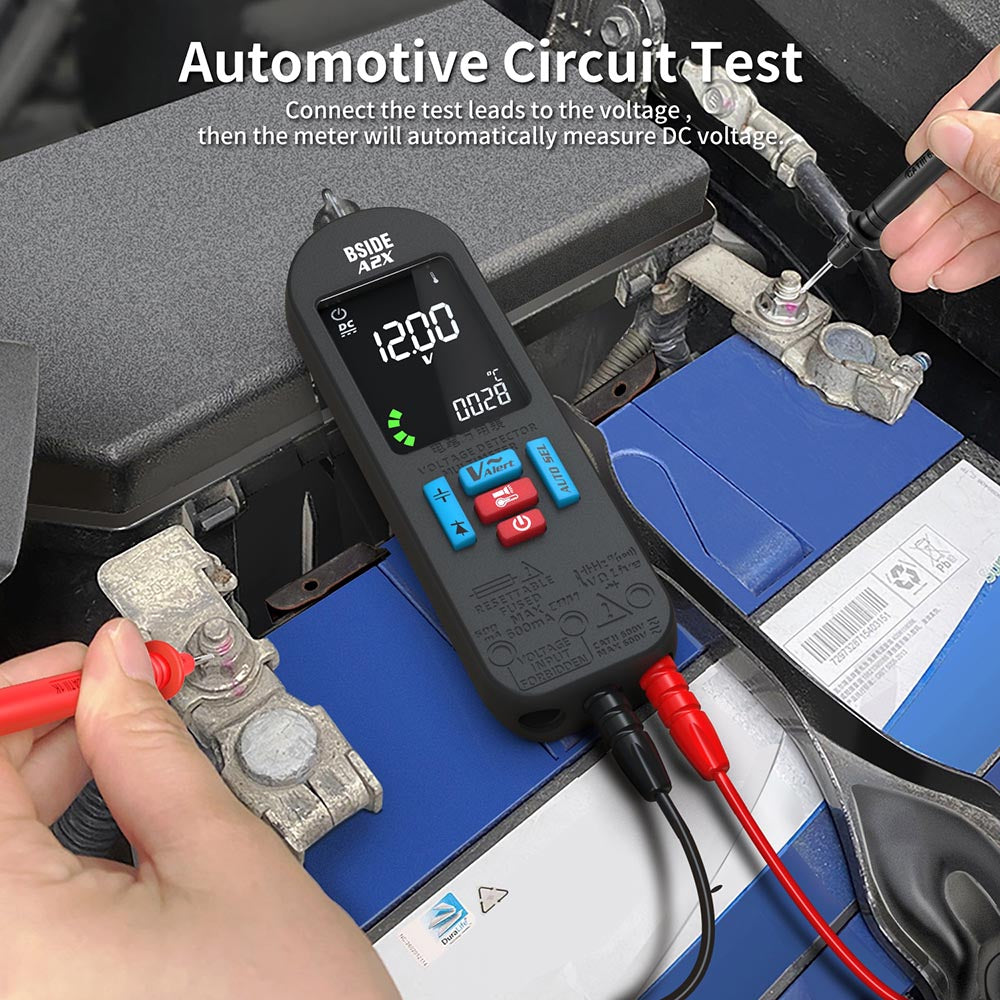
- Battery terminals
- Relay modules
- Wiring connections
- Heating around electronic control components
For automotive maintenance, the advantage is not only measurement accuracy, but also speed. A quick thermal scan can guide the user toward the area that needs deeper testing.
BSIDE SH6 vs. Other Brands
There are several ways to compare the SH6. Some products, like the Fluke 279 FC and FLIR DM285, are well-known professional thermal multimeters. Others, like the Klein Tools MM450, are more traditional digital multimeters without built-in thermal imaging.
The goal here is not to say one tool is “best” for everyone. The better question is: Which tool makes sense for the job, budget, and workflow?
|
Product |
Main Positioning |
Thermal Imaging |
Multimeter Function |
Best For |
|---|---|---|---|---|
|
Thermal imager + graph multimeter |
Yes |
Yes |
Users wanting visual thermal inspection, touchscreen operation, and accessible pricing |
|
|
Fluke 279 FC |
Premium thermal multimeter |
Yes |
Yes |
Professional electricians needing Fluke ecosystem and reporting workflow |
|
FLIR DM285 |
Industrial imaging multimeter with IGM |
Yes |
Yes |
Industrial users who prioritize FLIR thermal imaging technology |
|
Klein Tools MM450 |
Slim digital multimeter |
No built-in thermal imager |
Yes |
Users needing a compact standard multimeter for everyday electrical checks |
The Fluke 279 FC is described as a full-featured digital multimeter with integrated thermal imaging, built to help users find, repair, validate, and report electrical issues more quickly. It also supports Fluke Connect in supported regions, allowing measurements or thermal images to be viewed and saved through the app/cloud workflow.
The FLIR DM285 is an industrial imaging multimeter using FLIR’s IGM approach. FLIR describes it as an industrial imaging multimeter, and third-party product information lists a 160 × 120 thermal resolution, equal to 19,200 thermal pixels.
The Klein Tools MM450, by comparison, is a slim TRMS auto-ranging multimeter that measures AC/DC voltage, AC/DC current, resistance, temperature, capacitance, frequency, duty cycle, diode, and continuity, but it is not positioned as a thermal imaging multimeter.
So where does the BSIDE SH6 fit?
The SH6 is most attractive for users who want the thermal + multimeter workflow without immediately jumping into the price range of some premium industrial brands. It offers a useful combination of visual inspection, touchscreen operation, storage/export, and general multimeter functions in a compact tool.
When the BSIDE SH6 Makes the Most Sense
The SH6 is a strong fit if you often ask questions like:
- Why is this breaker warmer than the others?
- Which PCB component is overheating?
- Is this HVAC control board generating abnormal heat?
- Is this connector, relay, or terminal under stress?
- Can I document the issue with an image before testing further?
- Can I carry one tool instead of a thermal camera and multimeter separately?
For many independent technicians, electricians, DIY repair users, and workshop owners, the answer may be yes.
The SH6 is especially useful when the job requires quick visual diagnosis, not only electrical readings.
When You Might Choose Another Tool
A higher-end thermal multimeter may make more sense if you need:
- Advanced reporting software
- Enterprise-level calibration documentation
- Integration with a specific app/cloud ecosystem
- Higher-end brand standardization across a large company
- Specialized industrial thermal imaging requirements
For example, Fluke’s 279 FC is built around professional reporting and the Fluke Connect ecosystem. FLIR’s DM285 is strongly positioned around FLIR’s thermal imaging and IGM workflow.
On the other hand, if you only need basic voltage, current, resistance, continuity, and capacitance checks, a standard multimeter like the Klein Tools MM450 may be enough.
That is why the SH6 should be seen as a practical choice for people who want more diagnostic visibility than a regular multimeter, but do not necessarily need the highest-end industrial platform.
Real-World Example: Finding a Hidden Electrical Problem
Imagine a technician is checking a small electrical control cabinet. Everything appears normal at first glance. The circuit is still working, and voltage readings may not immediately show a serious issue.
With a thermal imager, the technician notices one terminal block is significantly warmer than nearby connections. That visual clue suggests a possible loose connection or increased resistance at that point.
The next steps become much more focused:
- Scan the panel with thermal imaging.
- Identify the abnormal hotspot.
- Shut down power safely if required.
- Inspect the connection.
- Use the multimeter to confirm voltage, resistance, or continuity.
- Repair the connection.
- Recheck the temperature after the system runs again.
This is exactly where a thermal imager multimeter becomes meaningful. It does not just give a number; it helps guide the troubleshooting path.
Real-World Example: PCB Repair
For PCB troubleshooting, a shorted component may heat up faster than the surrounding board. Without thermal imaging, users may need to test many components manually.
With the SH6, the user can first look for a hot area on the board. If one IC or capacitor heats abnormally, the multimeter function can then be used to test nearby components.
This can reduce guesswork and make small electronics repair more efficient.
Key Buying Considerations
Before choosing any thermal imaging multimeter, users should think about:
1. Thermal Resolution
Higher thermal resolution gives more detail. This matters for small components or more precise thermal analysis. For general inspection and troubleshooting, even moderate thermal resolution can still be very useful.
2. Multimeter Functions
A good thermal multimeter should still work well as a meter. Look for voltage, current, resistance, capacitance, diode, continuity, and temperature-related functions depending on your workflow.
3. Safety Rating
For electrical work, CAT rating matters. The SH6 is promoted with CAT III 600V, which is useful for many building electrical and maintenance scenarios.
4. Portability
If a tool is too large or complicated, it may stay in the toolbox. A compact tool with both thermal and electrical functions is more likely to be used often.
5. Image Storage and Export
For maintenance work, documentation matters. Built-in storage and data export can help users save images for customer reports, repair logs, or before-and-after comparisons.
Final Thoughts: Is the BSIDE SH6 Worth Considering?
The BSIDE SH6 Thermal Imager Digital Multimeter is a practical tool for users who want to combine thermal inspection and electrical testing in one device.
It is especially useful for:
- Electricians checking panels and terminals
- HVAC technicians inspecting electrical and thermal issues
- Electronics repair users diagnosing hot PCB components
- Automotive technicians checking wiring, fuses, and modules
- Maintenance workers who need quick visual troubleshooting
Compared with premium options from Fluke and FLIR, the SH6 is positioned more as an accessible, feature-rich option for practical troubleshooting. Compared with a standard digital multimeter, it offers a much more visual way to understand what is happening inside an electrical or electronic system.
For users who want to measure smarter, work safer, and troubleshoot faster, the BSIDE SH6 is worth a serious look.