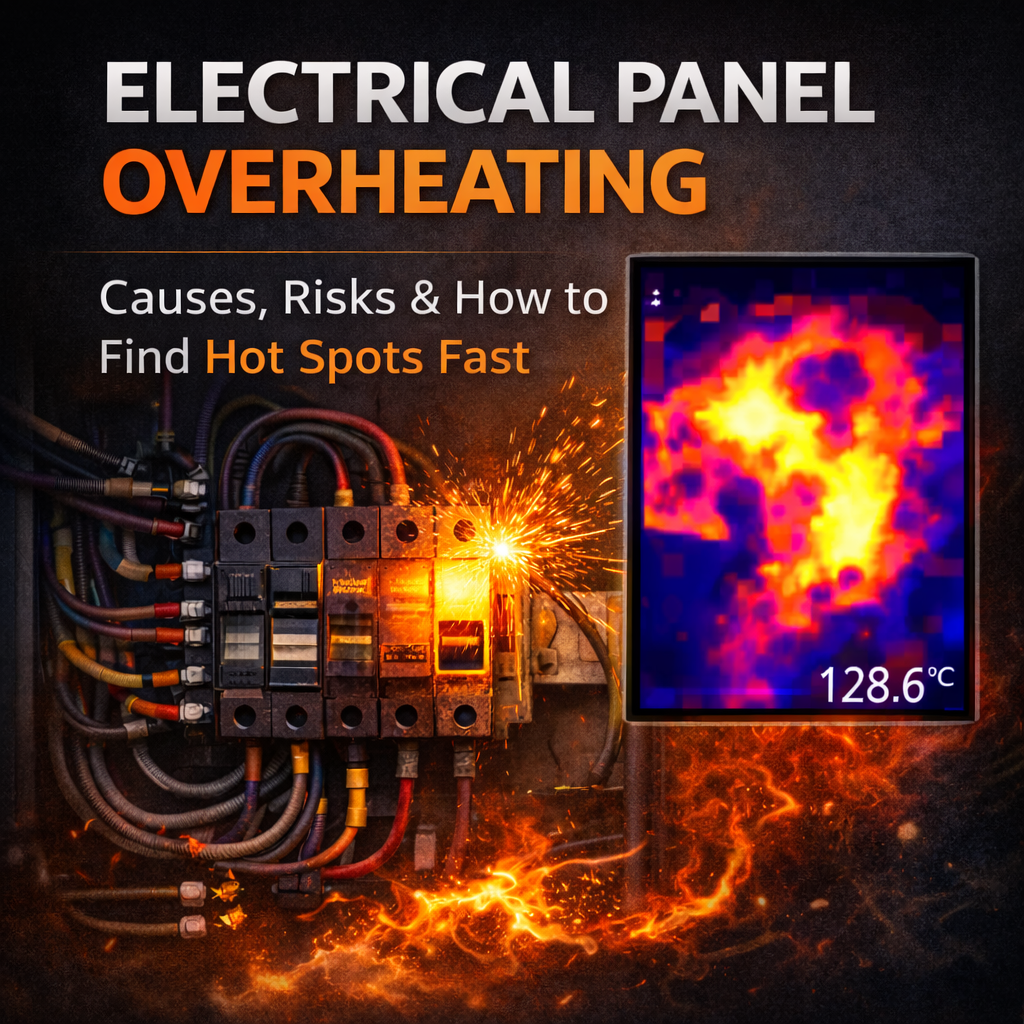
Electrical panels rarely fail without warning.
In most cases, the warning is already there — heat.
The challenge is that overheating inside an electrical panel often develops while everything still appears to be operating normally. Breakers don’t trip, loads look balanced, and voltage readings seem fine. Yet somewhere inside the panel, a connection is slowly deteriorating.
Understanding why electrical panels overheat, what risks this creates, and how to quickly locate the real hot spot can prevent unexpected downtime and serious safety issues.
Why Electrical Panels Overheat
Overheating is rarely caused by excessive current alone. In most real-world installations, the root cause is localized resistance.
1. Loose or Improperly Torqued Connections
This is the most common cause of panel overheating.
Even a slightly loose terminal increases contact resistance. Under load, that resistance converts electrical energy directly into heat. The circuit may continue to operate normally, which is why this issue often goes unnoticed.
Vibration, thermal expansion, and improper installation torque all contribute to this problem over time.
2. Oxidation and Corrosion
Oxidation forms an insulating layer between conductors and terminals, increasing resistance at the contact point.
This is especially common in:
-
Older electrical panels
-
Outdoor or high-humidity environments
-
Aluminum or mixed-metal connections
Even minor corrosion can generate significant heat when current flows continuously.
3. Aging Components and Materials
As electrical panels age, contact pressure decreases and conductive surfaces degrade. Springs lose tension, terminals loosen slightly, and resistance increases.
The system still functions electrically — but its thermal safety margin becomes much smaller.
4. Uneven or Localized Load Stress
In multi-phase systems, total current may appear balanced while a single termination point overheats due to poor contact or mechanical stress.
Checking only overall load values often misses these localized problems.
Why Overheating Is Dangerous
Heat is not just a symptom — it accelerates failure.
As temperature rises:
-
Metals expand and loosen further
-
Oxidation accelerates
-
Resistance increases even more
This creates a feedback loop that can quickly lead to insulation damage, nuisance trips, equipment failure, or fire hazards.
Many serious panel failures start with small, unnoticed temperature differences.
Why Traditional Electrical Testing Often Misses Hot Spots
Standard electrical tests have limitations:
-
Continuity tests are performed with little or no load
-
Voltage checks do not reveal localized resistance
-
Current measurements show overall circuit load, not heat concentration
A faulty connection can pass all basic electrical tests until the moment it fails.
In situations like this, technicians often need a tool that can visually identify abnormal heat while still allowing electrical verification at the same point. A thermal imaging multimeter is particularly useful because it helps confirm whether a suspected issue is caused by heat buildup rather than overall circuit load.
The Fastest Way to Find Hot Spots: Thermal Inspection
Thermal inspection allows technicians to see what electrical meters alone cannot.
By scanning a live electrical panel under normal operating conditions, it becomes easy to identify:
-
Abnormally hot terminals
-
Uneven heating across similar breakers
-
Connections that heat up without corresponding current increases
For troubleshooting work, many technicians prefer a compact thermal imaging multimeter (such as the BSIDE SH9) that allows them to scan for hot spots and immediately verify voltage or current without switching tools.
What Temperature Difference Matters?
Absolute temperature is less important than comparison.
Practical field guidelines commonly used include:
-
10–15°C above surrounding components → early warning
-
20–30°C difference → corrective action recommended
-
40°C or more → high risk, immediate attention required
Two identical connections under similar load conditions should never show a significant temperature difference.
Where to Check First Inside a Panel
If inspection time is limited, focus on the highest-risk locations:
-
Main breaker terminals
-
Feeder cable lugs
-
Busbar connections
-
Contactor and relay terminals
-
High-current distribution points
In larger panels or industrial environments, higher thermal resolution and a wider temperature range make subtle issues easier to detect. This is why some technicians choose higher-spec thermal multimeters like the BSIDE SH7 when performing routine preventive inspections on critical systems.
A Common Real-World Scenario
A facility reports intermittent motor trips during peak operation. Electrical readings appear normal.
A thermal scan reveals one breaker terminal operating 28°C hotter than adjacent breakers, despite carrying similar current. The terminal shows slight discoloration caused by oxidation and reduced contact pressure.
After cleaning, re-terminating, and properly torquing the connection, the issue disappears — without replacing any components.
In cases like this, having thermal visibility and electrical measurement combined in one device significantly shortens troubleshooting time and reduces repeat inspections.
Preventing Electrical Panel Overheating
Detection is important, but prevention is even more effective.
Best practices include:
-
Torquing all connections to manufacturer specifications
-
Avoiding mixed-metal connections without approved connectors
-
Performing thermal inspections under normal load
-
Recording baseline temperatures for future comparison
Electrical panels rarely fail suddenly — deterioration happens quietly.
Final Thoughts
Electrical panel overheating is predictable, detectable, and preventable.
The challenge is not understanding electrical theory, but recognizing heat as an early warning signal. Traditional measurements alone often miss the problem. Thermal inspection reveals it immediately.
When technicians can see heat and verify electrical conditions at the same time, problems are solved earlier, safer, and with far less disruption.
Heat doesn’t lie — you just need the right way to see it.